On this page5 sections
1. The Risk of Permanent Storage
In standard email services like Gmail, Outlook, or Yahoo, every email you receive is stored indefinitely unless manually deleted. If your account credentials are compromised, or if a service holding your forwarded messages is subpoenaed or hacked, your entire historical communication archive is exposed.
2. Principles of Ephemeral Architecture
Ephemeral computing enforces a strict lifespan on data. Once data serves its immediate operational purpose—such as confirming an account creation or delivering a one-time verification token—it is securely overwritten and purged from active database storage.
3. How 10-Minute Auto-Purge Works
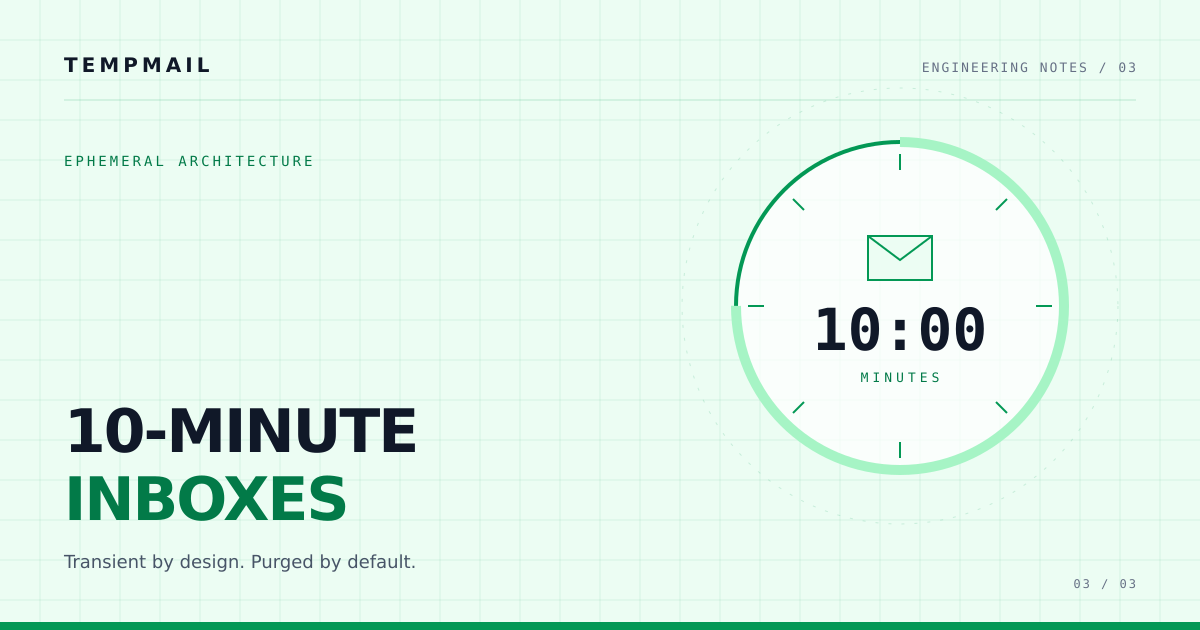
At Tempmail, all public web inboxes operate on a strict 10-minute ephemeral retention schedule. Incoming messages are streamed in real time to your active browser session. After 10 minutes, background cron workers remove message bodies, HTML payloads, and attachments from disk, ensuring that sensitive data never lingers publicly.
4. Threat Models Mitigated by Ephemeral Mail
- Shoulder Surfing & Shared Devices: If you step away from a public terminal or shared workstation, your temporary mailbox automatically cleans itself up.
- Cross-Site Correlation: Ephemeral addresses cannot be used by tracking companies to build longitudinal behavior profiles over months or years.
- Server-Side Data Breaches: Because message content is permanently deleted after 10 minutes, a breach of ephemeral servers yields zero historical user content.
5. Transient by Design
For modern internet users and developers, adopting temporary disposable mail isn't just a convenience—it is a fundamental privacy posture. Shield your real identity with 10-minute disposable email.
About the author
Data Retention & Cryptography
The privacy architecture team designs Tempmail's ephemeral inbox lifecycle, retention limits, and abuse-resistance controls.
Tempmail is the product this team builds. Our editorial policy covers sourcing, testing, corrections, and how we disclose that relationship.
Sources & further reading
Try it without signing up
The address on the home page is ready in a second. Copy it, use it anywhere, and read the reply here — no account, no ads.